
Cross-Cultural · Leadership
Healthy Conflict

Conflict that is not named does not go away. It grows.
After This Module
- Explain the difference between conflict and healthy conflict.
- Recognise why conflict feels unsafe for people who have been hurt by unhealthy conflict in the past.
- Distinguish between giving way and avoiding, using three simple questions.
- Describe the five rules for healthy conflict and what each one asks of you.
- Apply the rules to one conflict you have avoided, by naming it in a safe place this week.
Every team has conflict. People who work closely together will see things differently, and that is normal. What matters is what the team does with it.
When a team names a conflict and works through it with respect, it becomes healthy conflict. Healthy conflict does not divide a team. It brings people closer together and helps them move forward as one.
This module explains what healthy conflict is, why conflict often feels unsafe, and how to create a safe place where a team can face it.
Key terms
What is conflict?
Researchers define conflict in different ways. Three definitions are widely used. Each one looks at a different part of conflict.
“Opposing action of incompatibles (as of divergent ideas, interests, or persons).”
Focus: action. Conflict is something people do.
“A process that begins when one party perceives that another party has negatively affected, or is about to negatively affect, something that the first party cares about.”
Focus: perception. Conflict starts inside one person.
“An interactive process manifested in incompatibility, disagreement, or dissonance within or between social entities.”
Focus: interaction. Conflict happens between people or groups.
Conflict
Conflict is when people who depend on each other see their goals, needs or views as opposed, and at least one of them feels it.
Healthy conflict
Healthy conflict is when people face a conflict openly and with respect, and through it gain unity, clarity and trust. After the conflict, they continue together in unity.
Why this definition of conflict
It takes one element from each of the three definitions above. It adds one element that matters for teams.
- People who depend on each otherIn a team, the work connects people. A difference between them affects the work. That is why it cannot be ignored.
- See their goals, needs or views as opposedConflict depends on how people see the difference.2 It can exist before anyone says a word.
- At least one of them feels itResearchers describe a stage called "felt conflict", when the difference starts to affect a person's emotions.4 Conflict can be one-sided. One person can carry it while the other does not know. It is still conflict, and it still affects the team.
Why this definition of healthy conflict
The definition of healthy conflict describes the result. A conflict is healthy when people come out of it with more than they had before. They gain three things:
Research on structured disagreement suggests that, handled well, conflict can lead to better decisions. This works best when people share a goal and follow clear rules.5
Conflict itself is not healthy or unhealthy. The word healthy describes what a team does with it.
Why teams avoid conflict
Conflict feels unsafe
Many people have lived through unhealthy conflict. It may have happened in a family, a school, a church or an earlier team. The conflict ended in shouting, blame or silence. A relationship broke. Someone lost a position or a place in the group.
People remember this. When a new conflict starts, the old fear comes back. They feel unsafe and afraid, even when the new team is different. So they stay quiet. To them, silence feels safer than speaking.
Research on teams supports this. Teams learn and grow when members believe it is safe to take risks with each other.6 When people think leaders do not welcome disagreement, they hold back their concerns.7 Many people hold back even when no one in their current team has punished them for speaking. They follow unspoken rules, such as "do not embarrass the leader". The risk is assumed, not experienced.8
This is why a leader cannot only tell people to speak up. The fear is real, even when the danger is not. People need to see that this place is safe before they will name a conflict.
Unnamed conflict piles up
Conflict that is not named does not disappear. Small conflicts pile up. When emotions run high, they come out together, often over something small. Counsellors use the term "gunnysacking" for this: storing complaints in a sack until it bursts.9
How unhealthy conflict grows
One model, used widely by mediators, describes conflict growing in nine stages.10 In the early stages, opinions harden, but people still want both sides to win. In the middle stages, each person wants to win and the other to lose. In the last stages, both sides are willing to lose, as long as the other side loses more. After a certain point, people cannot solve it alone. They need outside help.
People who have lived through the later stages carry that memory. This is one reason why conflict feels unsafe. Healthy conflict names a difference in the early stages, while both people still want each other to win.
From the outside, giving way and avoiding look the same. In both, a person stays quiet and lets the matter go. Conflict research shows that the reasons behind them are different.11
Giving way comes from care for the other person. You choose to let the matter go, and it is settled for you. In many cultures, giving way is a sign of maturity and respect. It is a good thing, and it keeps many teams healthy.
Avoiding comes from fear or from wanting to escape. You stay silent, but the matter is still there. It stays with you and adds to the pile.
Three questions to tell them apart
- Was the matter named, at least to yourself and in prayer?
- Is it finished, with no bad feeling left?
- Has it stayed away, with no need to bring it back?
If the answer to all three is yes, you gave way. If the matter keeps coming back, or the bad feeling stays, it was avoiding. That conflict still needs to be named.
"Face" is the respect and standing a person has in the eyes of others. In many cultures, direct confrontation in front of others causes loss of face for both people.
Face-negotiation theory studies how people protect face during conflict.12 In cultures that value the group, people often protect the other person's face. When they avoid conflict or give way, it often comes from concern for the other person. It does not come from a lack of care.
This matters for leaders who work across cultures. A team member who stays quiet in a meeting may be protecting the group. Asking for open debate in front of everyone may feel unsafe to them.
Indirect naming is still naming
Naming conflict does not have to be direct. It can happen in a private conversation, through a question, a story, or a trusted third person. The prophet Nathan named David's sin through a story (2 Samuel 12). What matters is that the conflict is named and not left hidden.
Researchers separate two kinds of conflict in teams.13
Task conflict is a difference about the work: the plan, the method, or what to do first.
Relationship conflict is tension between the people themselves: dislike, irritation or hurt.
Relationship conflict harms teams. Research agrees on this.14,15 Task conflict is less simple. One large review found that it often harms team performance as well.14 A later review of 116 studies found that task conflict can help, for example in decision quality, when it stays separate from relationship conflict.15
So conflict does not automatically make a team better. Handled well, it can. The rules later in this module help keep a difference about the work from turning into a conflict between people.
- Psychological safety and learning behavior in work teams. Amy Edmondson's original study of safety in teams (full paper, PDF).
- Implicit voice theories. A summary of why people stay silent even when no one has punished them.
- Understanding team effectiveness. In an internal study of its own teams, Google found psychological safety was the most important of five team factors.16
- How winning teams navigate conflict. A short summary of a study of 57 student project teams.
- Constructive controversy. A summary of how groups can disagree in a structured way and reach better decisions.
- Glasl's model of conflict escalation. An overview of all nine stages.
See it
What healthy conflict looks like
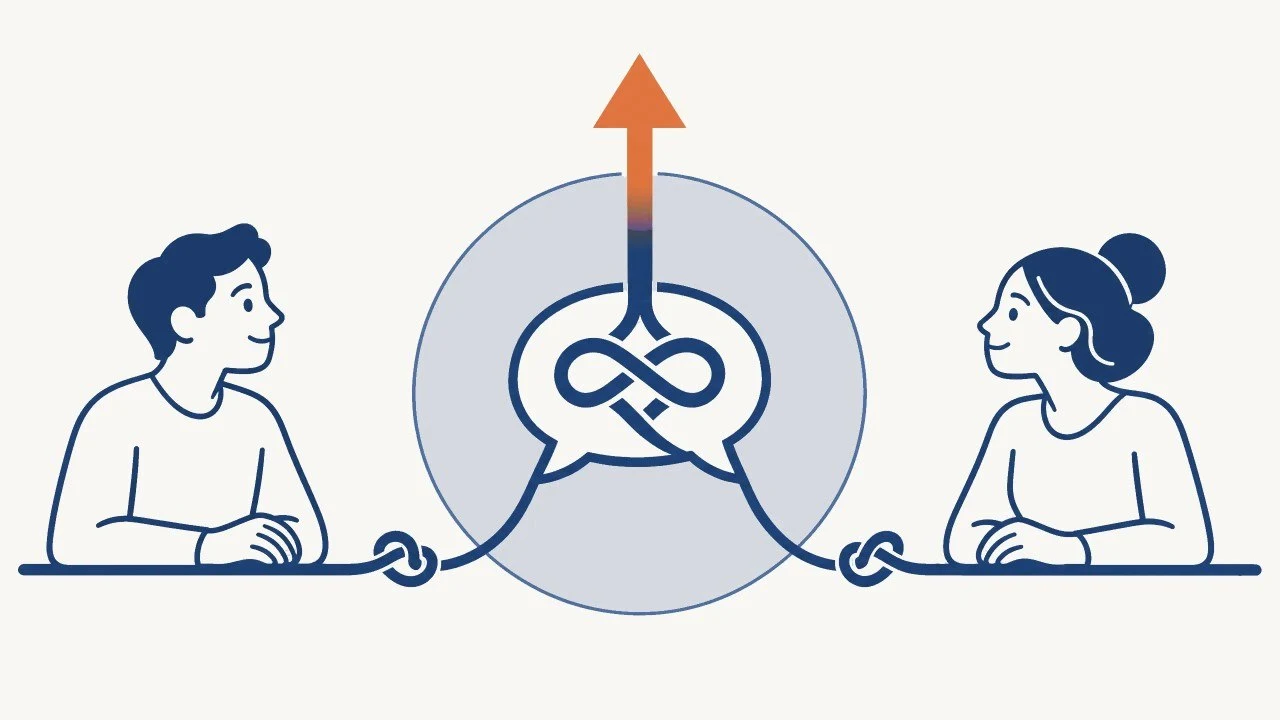
Both people bring their knot, the conflict, to the table. They do not hide it. In the safe place they talk it through together. One line comes out and goes forward. They leave with unity, clarity and trust.
What avoiding conflict looks like
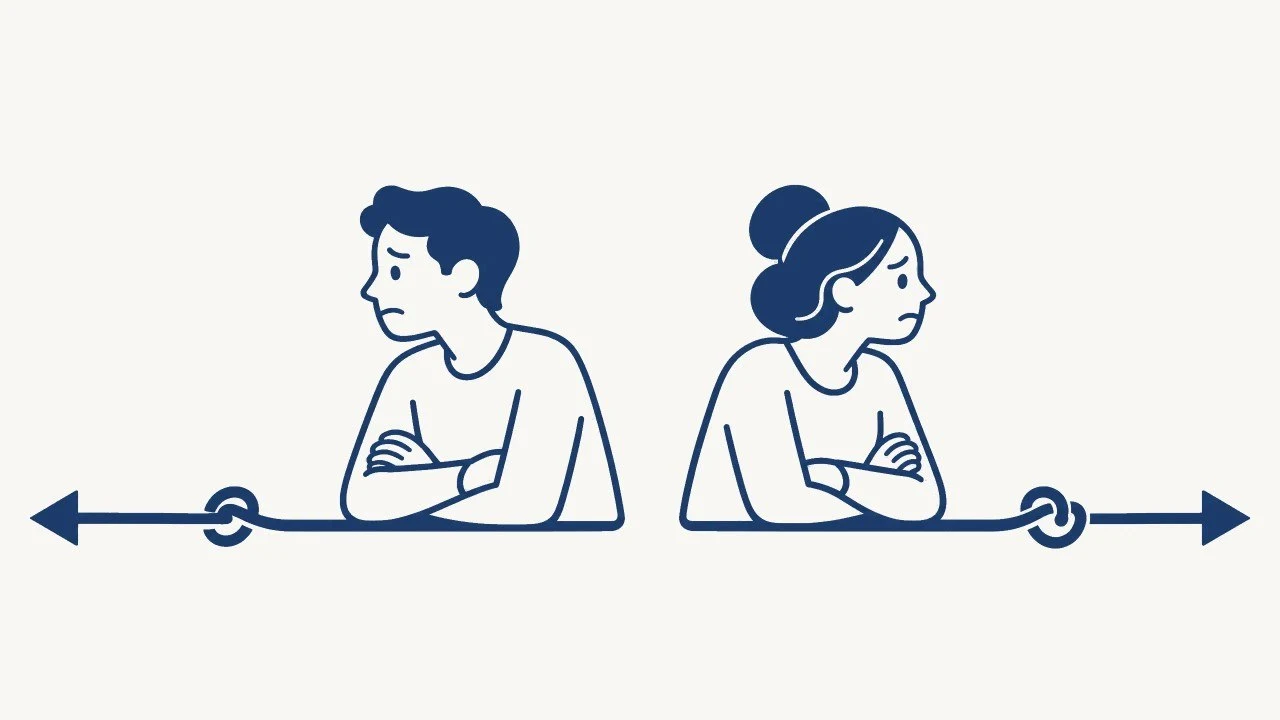
The same two people, with the same knots. But now they cross their arms and turn away. Nobody says anything. Each person carries the knot away alone, and the lines pull apart. The conflict is not gone. It is only unspoken, and the distance between them keeps growing.
Compare
Avoiding conflict and healthy conflict
The same team can look very different, depending on what it does with conflict.
The leader's role
Creating a safe place
A team will not name conflict until it feels safe to do so. The leader starts it, and the team builds it together.
Teams handle conflict better when they agree in advance how they will handle it. One study followed 57 student project teams. The teams that did well set clear rules for conflict and focused on facts, not on personalities.17
- Say that conflict is normal.Every team has it. Saying so removes the fear that conflict means the team is failing.
- Explain the rules before the conversation starts.People need to know how a conflict will be handled before they risk naming one.
- Choose the time and the place.Set a time, find a calm and private setting, and when needed, invite a neutral third person.
Safe is not the same as comfortable. A safe team still disagrees, and that can feel uncomfortable. Safe means people can disagree without fear of being punished for it.18
The rules
Five rules for healthy conflict
The leader explains these rules before the conversation starts. Every person in the conversation agrees to them.
Trust is a decision, not a feeling.
Come to the conversation ready to trust. You may not feel trust at this moment, and that is all right. You decide to trust the other person anyway. You do this because you want to move forward with this person. Where trust is low, people hear a disagreement about the work as a personal attack.19 Choosing to trust keeps the conversation about the problem.
There is no winner and no loser.
The goal is not to win the argument. The goal is a better result for the team. If one person loses, the whole team loses something.
Talk about the problem, not the person.
Describe what happened and how it affects the work. Do not describe the other person's character. People can solve a problem together. A judgement about a person can only be defended.
Listen until you can repeat the other person's view.
Before you answer, say back what you heard. Keep going until the other person agrees that you understood. You do not have to agree with them. You do have to understand them first.
Talk first, then adjust.
Do not quietly change your behaviour to get around the problem. Adjusting in silence is a form of avoiding. Talk first. Then both people adjust, based on what you agreed together.
You do not need a title to name a conflict. Start by raising it privately with the other person (Matthew 18:15). Use the same five rules, even if the other person has never heard of them.
If a private conversation does not feel safe, ask a trusted third person to help. You can also ask your leader to create a safe place for the conversation.
If you are afraid to speak, ask yourself where the fear comes from. Is it this team, or an earlier experience? The answer can help you decide on the next step.
These rules are for differences between people who work together. They do not cover abuse, harassment, misconduct or safeguarding concerns. Those must be reported to the right person, not talked through as a conflict.
Put it into practice
Make healthy conflict a team habit
Do not wait until a conflict happens. Healthy conflict works best when it is a normal part of how the team works.
Ask the question in every meeting
In every team meeting, ask one question: “Is there a conflict we need to resolve in a healthy way?” Ask it every time, even when you expect the answer to be no.
Why the routine matters
When the question comes every meeting, the door is always open. People know they will have a regular chance to raise something, small or large, before it becomes a problem. Nobody has to find the courage to start the conversation alone. The whole team uses the same words and the same five rules, so everyone knows what healthy conflict means and what happens when someone speaks up.
The leader’s task
Building this habit is the leader’s job. You ask the question. You guide the conversation through the five rules. When you are part of a conflict yourself, you go first. When the team sees you handle conflict calmly and fairly, they learn it is safe to do the same. Over time the routine shapes the culture of the team.
From the field
An example: two leaders at one table
Two leaders worked together in a children's home in Southeast Asia. One came from abroad. The other came from the local community. Both were committed to the work. Both had a clear vision and strong ideas about how the home should run.
From the first weeks, both of them knew that they saw things differently. They worked in different ways. They made decisions in different ways. They had different ideas about how to care for the children. None of this was hidden. They could both see the gap clearly.
But they could not talk about it.
The reason was not anger. They respected each other too much to say it. That respect stopped them from speaking. Neither wanted to damage what they had built. Neither wanted to make the other person uncomfortable. So they stayed careful and polite, and the gap stayed open.
One day, a third person who knew them both sat down with them. He told them he wanted to bring them to a table where conflict was going to happen. He thought they needed it, and he thought it was safe.
He set a few ground rules. It was not a long list. It was enough to explain what kind of conversation this would be.
Then both leaders talked honestly. It was not comfortable. There were moments of real tension. There were also moments when one of them said something that the other really heard. Views that each had held for a long time began to soften.
They did not solve everything. Some differences remained. But they left with something they did not have before: a way to talk with each other about the things that mattered. Their unity grew from that table. It grew because the conflict was finally allowed to be named.
What this example shows
- Respect can lead to silence. Silence did not protect their unity. It kept the gap open.
- A third person created a safe place. Both leaders knew the conversation would be hard, and both knew it was safe.
- The ground rules came first, before anyone spoke.
- Not everything was solved. Unity, clarity and trust still grew.
Faith Anchor
Silence is not peace
Paul tells us to work to keep the unity of the Spirit (Ephesians 4:3). Unity does not keep itself.
He also writes: "Be angry and do not sin; do not let the sun go down on your anger, and give no opportunity to the devil" (Ephesians 4:26-27, ESV). Anger that is left alone gives the enemy room.
Paul's warning is simple. Anger that is held in and never dealt with gives the enemy a foothold. The problem is not the quiet itself. It is what we leave unresolved. Conflict that is not named does not go away. It grows.
Not all conflict comes from the enemy. James says it starts in our own desires (James 4:1). We are responsible for our part.
God also tells his people not to hate a brother in the heart, but to speak to him honestly (Leviticus 19:17).
This is for differences between people who are safe with each other. If you are being harmed, bullied or abused, you do not have to face that person alone. Tell someone with authority to act, or a trusted person outside the situation.
Avoiding conflict is not peace. Healthy conflict names the problem early, in love, and directly with the person involved, in a way that honours them. That is how a team keeps its unity.
Reflect
Is there something unresolved in your team that is safe and right to name? What would it look like to name it in love this week?
Key takeaways
What to remember
- Conflict is when people who depend on each other see their goals, needs or views as opposed, and at least one of them feels it.
- Healthy conflict is conflict faced openly and with respect. Through it, people gain unity, clarity and trust, and continue together in unity.
- Conflict feels unsafe for many people because of unhealthy conflict in the past. The fear is real, even when the danger is not.
- Unnamed conflict does not go away. It piles up and comes out when emotions run high.
- The leader creates a safe place and explains the rules before the conversation starts.
- Trust is a decision, not a feeling. Choose to trust because you want to move forward together.
Check your understanding
Six quick questions
One question at a time. After each answer you will see why it is right or not. This is for you, not a test.
What makes a conflict healthy?
Want the full library of modules? Create an account with Crispy Development
Related Resources
Understanding High-Context Cultures
Why people say less but mean more, and how that shapes conflict
Power Distance
Why some team members go quiet when the leader is in the room
Building Trust Across Cultures
Healthy conflict needs trust. This module shows how to build it
Giving Feedback Across Cultures
How to say hard things so the other person can hear them